
How to spend 3 perfect days in Athens
I’m obsessed with Greece.
From the moment I stepped foot in this beautiful country, it was love at first mouthful. There’s something about Greece feels so healing. Being there calms my mind, soothes my worries, and leaves me feeling healthier and stronger than ever. And the food? Guys. I’ve been to over 90 countries and Greece is my number one destination for eating.
I believe Athens is one of the greatest European cities out there, and it’s the perfect destination for a city break. This city is magnificent! With great street art, incredible food, colourful neighbourhoods, and so much history, there really is something for everybody.
I think three days is the perfect amount of time to spend in Athens, so today, I’m excited to share exactly how you can do so.
DAY ONE: BEGIN DIVING INTO ATHEN’S HISTORY
The first thing you should do in Athens is a no-brainer: buy your combined ticket.
What’s that?
Well, it costs €35, and for that, you’ll gain access to all of the main attractions in Athens, including the Acropolis. Not only will you get to explore the most famous site in the city, but you’ll also be able to enter the Ancient Agora, Roman Agora, Hadrian’s Library, Aristotle’s School, Kerameikos, and the Olympieion — you can visit each of these once over a five-day period, and you can buy the ticket at the entrance to any of them. You’ll save a whole bunch of money by doing this, so the only reason not to get the combined ticket is if you think you’ll only want to see one or two of the attractions.
However, if you happen to be reading this before you get to Athens, I highly recommend buying your combined ticket online. Doing so means you get to avoid the long lines for tickets and can simply show the QR code on your phone to gain entry.
If you haven’t bought your combined ticket online, once you arrive in Athens, head to the Ancient Agora and join the queue for one.
The Ancient Agora was built in the 6th Century BC and was once the centre of life in ancient Athens. Used as a marketplace and gathering spot, this was where you’d have found people like Socrates, Aristotle and Plato casually wandering around town. Almost all of the commercial, political, and social activity took place in the ancient Agora, so this is a hugely important area to check out.
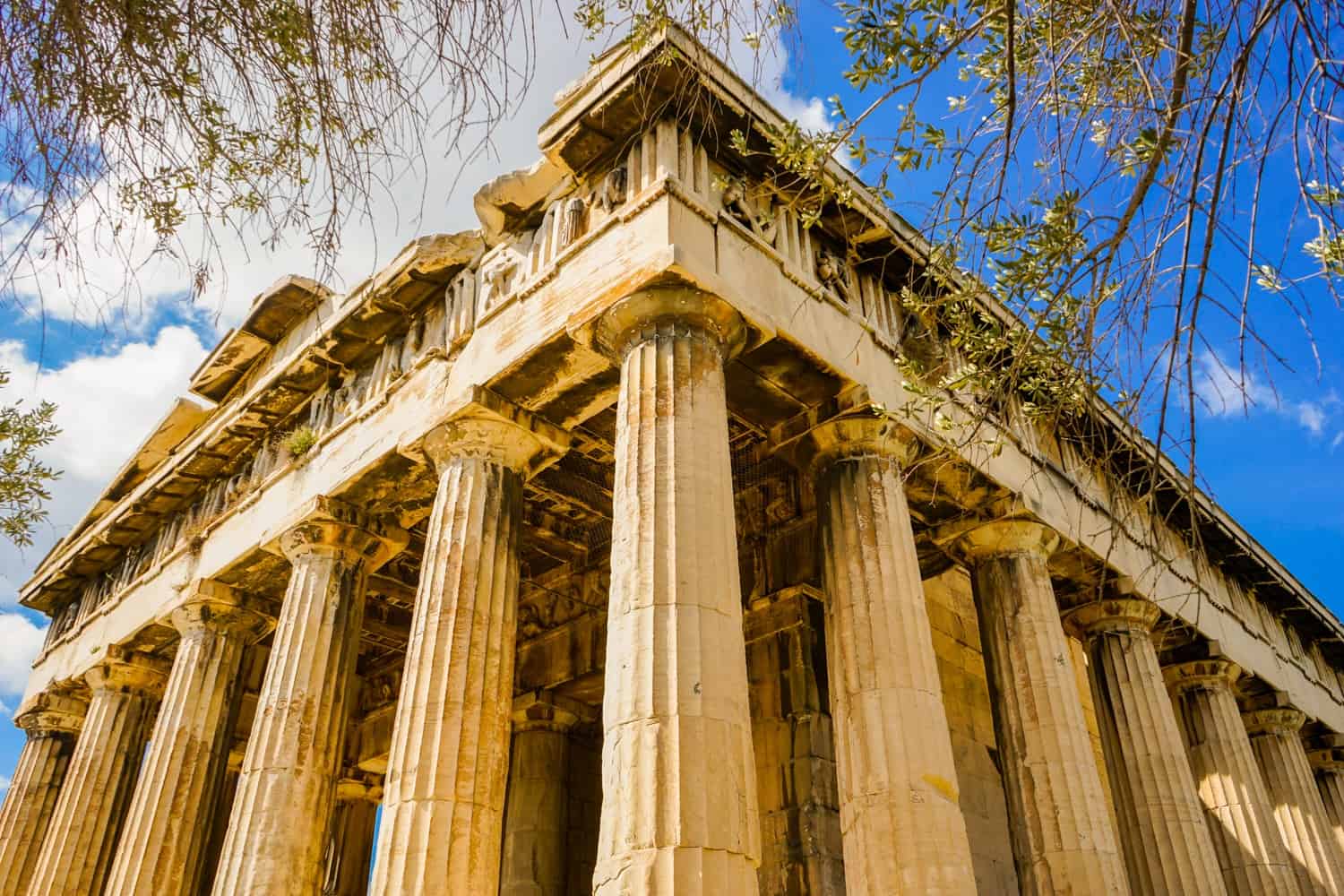
Once you’ve entered the Ancient Agora, head first to the Temple of Hephaestus, which is the best-preserved temple in Athens. And that sure is impressive when you consider that it was built in 415 BC — it’s still in great condition!
The views were pretty acceptable, too.
Aside from the Temple of Hephaestus, the Ancient Agora is also home to your standard ruin remnants: collections of rocks, stumps, and fallen-down walls, hinting at the temples and stalls that would have once stood here. But, as always with ruins, you’ll have to use your imagination, because it is still a pile of rocks on the ground.
There’s the Stoa of Attalos here, too — built in the 2nd Century BC, although since reconstructed — which currently acts as a museum for the Ancient Agora. And the Byzantine Church of the Holy Apostles, which was built in 1000 AD, is one of the few structures in the Agora that’s still standing.
Before arriving in Athens, I kind of assumed it would feel like a poor man’s Rome, but at this point, I was well and truly eating my words. Athens was pretty goddamn awe-inspiring.
Next, you’ll want to make your way over to the Kerameikos Cemetery, which is another site that’s included in your combined pass. This spot was one of the most important regions of ancient Athens. Once used as a neighbourhood for pottery and painters, it was the place where all of those famous Athenian vases were produced.
It was later transformed into a cemetery: one of Athens’ most important.
As you wander the site, you’ll also be able to spot pieces of the Themistoclean Wall, which was built in 478 BC to protect the city from the Spartans.
I’m convinced that it’s impossible to have a bad meal in Greece: their cuisine is too delicious to mess up. I’ve yet to have a meal that wasn’t excellent in this country, whether I’ve been sat beside a congested motorway in the middle of nowhere, snacking at a taverna on a yacht in the Ionian, or dining in the most touristy parts of Athens.
The latter was exactly what we opted for at lunchtime, and it should have been terrible.
I settled on the most touristy restaurant on the most touristy of streets, with touts outside, and a menu in English with photos of the dishes. What can I say? We were starving by this point, so decided to give in and eat an overpriced, poor meal.
Except it was amazing! Because Greece.
While I wouldn’t necessarily recommend heading to a touristy restaurant for any of your meals in Athens, I suspect you won’t be all that disappointed if you do end up there. Eat anywhere in Athens! It’s always going to be delicious.
After lunch, it’s time to hit up the second Agora in Athens. The Roman Agora was built in the 1st century BC, financed by Caesar and Augustus, and like the Ancient Agora, was used as the city’s marketplace. You enter the site through the Gate of Athena Archegetis, which was built by Julius Caesar and dedicated to the goddess Athena.
The most well-known and well-preserved building is the Tower of the Winds: a large octagonal marble tower that functions as a sundial, weathervane, and water clock. It’s believed to be the first meteorological station in the world and it’s well-worth having a look inside.

Recent Posts

Where to eat like a local in Athens

11 Best Things to do in Athens
